
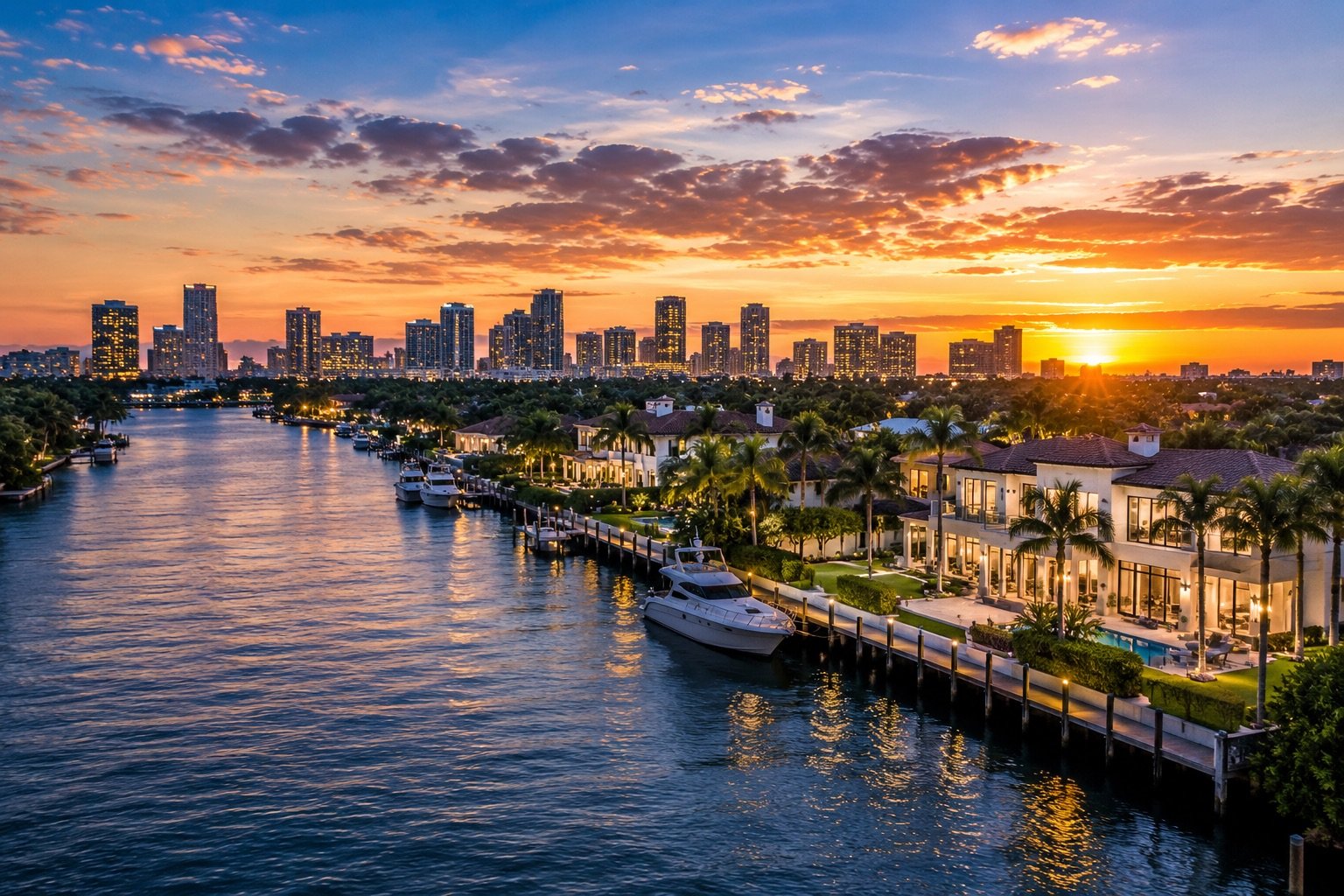
This South Florida real estate market update examines the latest mid-2026 trends in home sales, prices, inventory, luxury activity and mortgage rates across Broward, Palm Beach and Miami-Dade counties.
South Florida entered the second half of 2026 with renewed transaction activity, declining inventory and meaningful differences between the single-family and condominium markets. Elevated borrowing costs continue to influence affordability, but well-positioned properties—particularly luxury homes and desirable single-family residences—are still attracting serious buyers.
The market is not uniformly favorable to either buyers or sellers. Conditions vary substantially by property type, location, price range, insurance exposure and, in the condominium market, the financial condition of the association.
The central lesson for both buyers and sellers is straightforward: property-specific strategy matters more than broad market headlines.
South Florida Real Estate Market Update: Key Mid-2026 Trends
The latest housing data reveals several important developments:
- Residential sales increased across Broward, Palm Beach and Miami-Dade counties.
- Single-family median prices rose year over year in all three counties.
- Condominium prices and inventory conditions remained more varied.
- The market for homes priced at $1 million and above continued to outperform.
- Mortgage rates remained in the mid-6% range, keeping financing and monthly ownership costs central to purchasing decisions.
Statewide, Florida single-family closed sales increased 9.3% year over year in June 2026, reaching 26,036 transactions. Condo and townhouse sales rose 14% to 8,900 transactions. Florida’s median single-family sale price increased 4.9% to $432,000, while the condo-townhouse median rose 1.7% to $305,000.
South Florida Home Sales Accelerated in June
The current South Florida real estate market update shows that buyer activity strengthened considerably compared with June 2025.
In Broward County, total residential sales increased 21.1% year over year, from 1,938 to 2,347 transactions. Single-family sales rose 26.02%, while existing condominium sales increased 15.53%.
Palm Beach County recorded a 22.3% increase in total residential sales, rising from 2,008 to 2,456 transactions. Single-family home sales increased 24.85%, while existing condominium sales rose 18.64%.
Miami-Dade County experienced its strongest June in three years. Total residential sales increased 14.3% to 2,107 transactions, with single-family sales rising 16.8% and condominium sales increasing 11.9%.
Across the broader South Florida region, June sales increased 18.6% year over year, marking the tenth consecutive month of annual sales growth. Year-to-date sales were up 7.9%.
These figures indicate that buyers have not withdrawn from the market. Many have adjusted to current financing conditions and are moving forward when a property’s location, condition, price and ownership costs align with their objectives.
Single-Family Home Prices Remained Resilient
Single-family home values continued to rise across South Florida’s principal counties in June 2026.
Broward County’s median single-family sale price increased 2.39% year over year to $645,000. Palm Beach County recorded a larger 11.82% increase, bringing its median to $700,000. Miami-Dade’s single-family median increased approximately 3.7% year over year.
Countywide medians provide useful context, but they should not be interpreted as the value of every property within a county. A waterfront residence in Fort Lauderdale, a country-club home in Boca Raton and a suburban property in western Broward can respond very differently to market conditions.
Location, lot characteristics, waterfront access, renovation quality, insurance costs and neighborhood demand remain essential components of value.
Nevertheless, the regional data demonstrates that demand for well-located single-family homes remained strong enough to support continued price appreciation.
The Condominium Market Is More Nuanced
The condominium market requires a more detailed analysis.
Palm Beach County’s median condo price increased 3.17% year over year to $325,000. Broward County’s median declined 1.83% to $265,000, while Miami-Dade’s median condo price declined 3.15% to $431,000.
These county-level figures tell only part of the story. Buyers should evaluate each building based on its specific financial and physical condition, including:
- Association reserves
- Current and anticipated special assessments
- Monthly maintenance fees
- Master insurance coverage
- Structural and milestone inspections
- Pending litigation
- Rental and pet restrictions
- Financing eligibility
- Recent capital improvements
Only 21 of approximately 2,397 condominium buildings in Miami-Dade, Broward and Palm Beach counties were approved for FHA financing, according to data cited by MIAMI REALTORS® + RWorld. That limited eligibility can reduce the financed-buyer pool for certain buildings.
Two condominiums with similar list prices may therefore carry very different financial risks and long-term ownership costs. Buyers should review association documents carefully before the expiration of applicable due-diligence periods.
Inventory Conditions Differ Between Houses and Condos
One of the most important findings in this South Florida real estate market update is the contrast between single-family and condominium inventory.
South Florida’s active residential inventory declined approximately 18% year over year by the end of June. This reduction in available supply provides underlying support for prices, but the balance between buyers and sellers varies significantly by property type.
Broward County had 4.3 months of single-family supply, a level generally associated with a seller’s market. Existing condominiums had 10.1 months of supply, providing buyers with more selection and negotiating leverage.
Palm Beach County reported 3.9 months of single-family supply and 7.2 months of condominium inventory. This indicates tighter conditions for houses and a more balanced environment for condos.
The implications are important:
A well-priced single-family home in a desirable neighborhood may attract interest quickly because buyers have fewer alternatives. Condominium buyers may have more time to compare units, scrutinize association finances and negotiate on price or terms.
However, attractive, financially sound condo buildings can still outperform the wider condominium market. Inventory figures should always be interpreted alongside building quality, location and pricing.
Luxury Real Estate Continued to Outperform
South Florida’s luxury market remained one of the region’s strongest segments during the first half of 2026.
Sales of properties priced at $1 million and above increased 39.7% year over year in June and were up 21.9% year to date. Cash purchases represented 61% of year-to-date million-dollar sales.
Palm Beach County’s $1 million-plus sales increased 57% in June, while Broward County’s million-dollar transactions rose 35%. Miami-Dade’s $1 million-plus sales increased 29.1%.
At the ultra-luxury level, South Florida recorded 306 transactions of $10 million or more during the first half of 2026—the highest total recorded for that six-month period. Approximately 88% were all-cash purchases, and Miami-Dade and Palm Beach counties accounted for roughly 90% of those sales.
Luxury buyers are often less directly affected by mortgage-rate fluctuations. Demand in this segment remains concentrated around:
- Direct waterfront and boating access
- New or recently completed construction
- Exceptional architecture and design
- Privacy and security
- Premium views
- Large parcels
- Prestigious communities
- Convenient access to dining, business districts and private aviation
The continued strength of high-end sales reinforces the importance of specialized presentation and targeted marketing when selling a luxury property.
Mortgage Rates Continue to Influence Affordability
The average 30-year fixed mortgage rate was 6.58% as of July 23, 2026, while the average 15-year fixed rate was 5.96%.
These rates affect more than a buyer’s monthly principal-and-interest payment. They also influence:
- Total purchasing power
- Down-payment decisions
- Fixed-rate versus adjustable-rate financing
- Seller-paid interest-rate buydowns
- Cash-offer competitiveness
- Whether a buyer purchases now and refinances later
- The relative appeal of properties with lower recurring expenses
Buyers should evaluate the complete cost of ownership, including property taxes, homeowners insurance, flood insurance, association fees and anticipated maintenance.
A property with a lower purchase price may not necessarily be more affordable if it carries substantially higher insurance premiums or association expenses.
What Buyers Should Do in the Second Half of 2026
Buyers should approach the current market with preparation rather than waiting indefinitely for ideal conditions.
A strong purchasing strategy begins with a clear understanding of financing, liquidity and monthly carrying costs. Buyers targeting competitive single-family neighborhoods should be prepared to act when an appropriately priced property becomes available.
Condo buyers may have greater negotiating leverage, but they should dedicate additional attention to association finances, reserves, insurance and upcoming assessments.
Before making an offer, buyers should:
- Review recent closed comparable sales
- Understand the property’s insurance exposure
- Estimate taxes based on the anticipated purchase price
- Evaluate renovation and maintenance requirements
- Review applicable association documents
- Consider how long the property has been listed
- Structure contingencies to protect their interests
The correct strategy will differ between a newly listed waterfront residence and a condominium that has remained available for several months.
What Sellers Should Do in the Second Half of 2026
Stronger transaction volume does not mean that every property will sell quickly or at any asking price.
Today’s buyers are informed and highly attentive to condition, ownership costs and visible deferred maintenance. Sellers should focus on:
- Pricing based on current closed sales
- Professional photography and presentation
- Strategic property preparation
- Accurate and complete disclosure
- Clear records of improvements and maintenance
- Accessible insurance and association information
- A marketing plan tailored to the likely buyer
Broward single-family sellers received a median 96% of original list price in June, while condominium sellers received 93%. In Palm Beach County, the corresponding figures were 95% and 93%. These results reinforce the importance of setting a defensible initial asking price.
Condo sellers should gather budgets, reserve information, insurance materials, assessment notices and building reports before listing. Delays or uncertainty during the review period can weaken buyer confidence.
Luxury properties require more than basic MLS exposure. High-quality visual presentation, targeted distribution, privacy management and careful buyer qualification become increasingly important at higher price points.
What to Expect for the Remainder of 2026
The second half of 2026 is unlikely to produce one universal market trend.
Tighter single-family inventory should continue to support properly priced homes in desirable neighborhoods. The luxury segment may remain comparatively resilient because of its high concentration of cash purchasers.
The condominium market is likely to remain more building-specific. Properties in financially stable, well-maintained associations should be better positioned than units in buildings facing significant assessments, insurance challenges or financing restrictions.
Mortgage rates will remain a major variable. A meaningful decline could improve affordability and draw additional financed buyers into the market. Persistently elevated rates may continue to favor buyers with strong liquidity, substantial down payments or flexible financing strategies.
Based on rising sales and declining inventory, the current data supports a cautiously constructive outlook. However, future results will continue to vary by property type, municipality, condition and price range. This is an interpretation of current market indicators, not a guarantee of future performance.
Navigate the Market With a Clear Strategy
This South Florida real estate market update demonstrates why successful decisions require more than a general understanding of countywide statistics.
Whether you are considering a waterfront residence, luxury condominium, investment property or the sale of an existing home, the appropriate strategy should be tailored to the specific property and your objectives.
Explore current South Florida properties, view the D’Onofrio Realty Signature Collection, or request a confidential property valuation to begin a more personalized conversation.
Market statistics reflect the latest available June and July 2026 reporting and are provided for general informational purposes. Countywide statistics do not constitute an appraisal, guarantee of value, legal advice, financial advice or a prediction of future market performance.